Free Shipping on All Orders | 30-Day Easy Returns
Dog Boot Sizing and Fit Guide: Get the Perfect Match
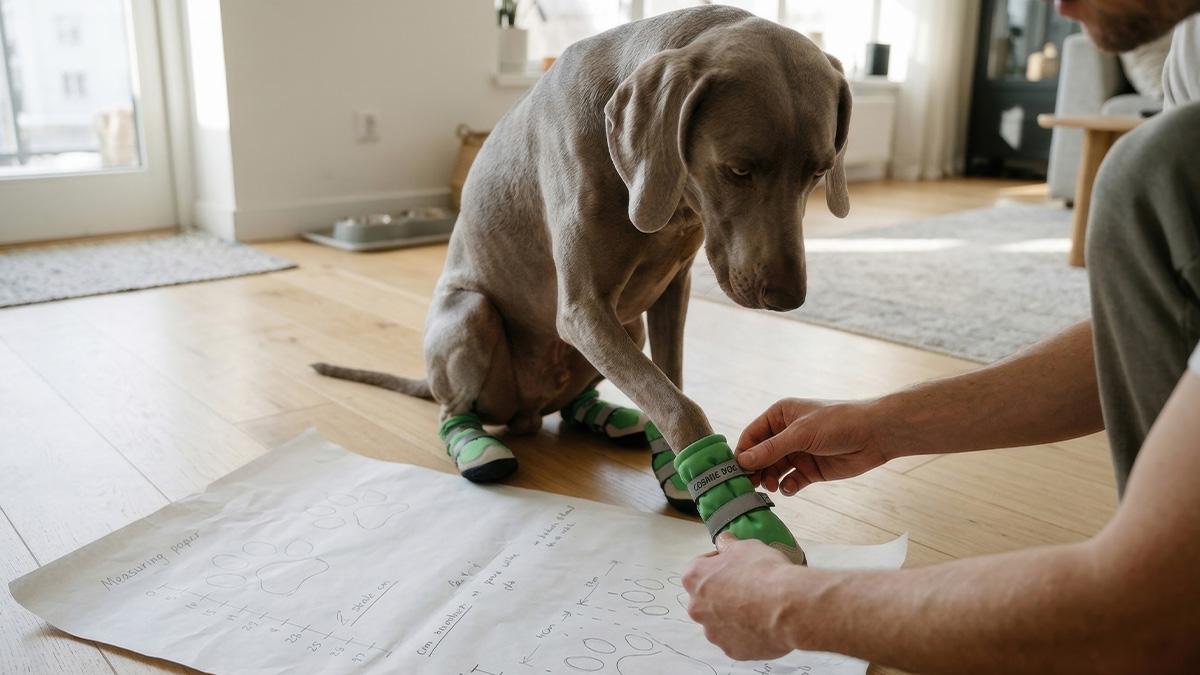
Table of Contents
Maybe you’ve watched a brand-new boot fly off your dog’s back foot halfway down the block. Or maybe you’ve found a red rub mark on a paw after what should have been an easy winter walk. Either way, you already know that dog boot sizing and fit can make or break your dog’s whole relationship with footwear. A well-made boot will still twist, slip, or chafe if its dimensions don’t match your dog’s real paws.
Most sizing problems come from two habits. The first is measuring a paw while it’s lifted in your hand. A dog’s toes spread once they carry body weight, so a paw that looks dainty in your palm takes up more room on the floor. The second is assuming all four paws are the same size. Many dogs have noticeably wider front paws and slimmer hind paws.
The fix is cheap and takes about 10 minutes. You need a sheet of paper, a pencil, and a little patience. Measure while your dog is standing. Measure the front and back paws separately. Then compare your numbers with the size chart for the exact product you plan to buy.
This dog boot measuring guide covers:
- How paw shape changes under weight
- A four-step paper-tracing method
- How sizing differs between small and large breeds
- How to tell whether a boot is too tight or too loose
The same rule applies whether you’re shopping for Chihuahua winter boots, everyday dog shoes, or tough boots for a big outdoor dog: measure the paw, check the product’s sizing, and test the fit before a full walk.
The Weight-Bearing Rule: Why Measuring a Lifted Paw Fails
Accurate dog boot sizing and fit starts with one idea. Measure the paw in the position it will be in inside the boot, which is standing on the ground.
Pick up your dog’s paw and you’ll feel the toes relax and fold in a little. Set it down and the toes and soft tissue spread outward to carry weight. That standing shape is the one the boot has to hold. Nobody walks around on a paw held in mid-air.
Why a lifted-paw measurement can steer you wrong
Picture yourself on the couch with your dog’s paw cupped in your hand while you hold a tape measure across it. It feels like a good measurement. In reality, that paw is probably narrower than it will be on the sidewalk.
Choose a boot from that smaller number, and the toe box can feel cramped once your dog puts weight down. Cramped toes mean friction, pressure, and an unhappy, stiff-legged walk. If you try to make up for it by sizing up a lot, you get the opposite problem: a boot that shifts, spins, and slides with every step.
Paws don’t spread by a fixed percentage. The difference depends on paw shape, body size, posture, and how you take the measurement. That’s why a weight-bearing paw measurement for dog shoes is a much more reliable starting point than measuring a relaxed paw in the air.
How weight-bearing measurement works
A standing dog spreads its load across the pads and toes. That contact area changes slightly as the dog shifts weight. The toes may fan out, and the outer edges of the loaded paw often measure wider than the same paw held up.
To capture that standing shape:
- Put a sheet of paper on a hard, level floor.
- Let your dog stand naturally with the paw flat on the paper.
- Keep the leg in a comfortable, neutral position. Don’t pull it forward or tuck it under.
- Mark the widest points of the loaded paw outline.
- Measure the width and length, then compare them with the manufacturer’s sizing instructions.
Don’t force your dog to put all of their weight on one leg. A natural, relaxed stance is all you need. A second person to hold a treat at nose level makes this much easier.
If your dog is older, stiff, or recovering from an injury and can’t stand comfortably, skip the weight-bearing method and ask your veterinarian for a safe alternative. Dogs with mobility problems often need different footwear features anyway, which we cover in Mobility and Traction Dog Boots: Arthritis & IVDD Guide.
Once you’ve decided to give your pup all-weather paw protection, getting the fit right is step one. Learn more about do dogs need shoes.
For more background on paw anatomy and everyday paw health, see the American Kennel Club’s canine care resources.
Front Paws vs. Back Paws: The “Set of Four” Myth
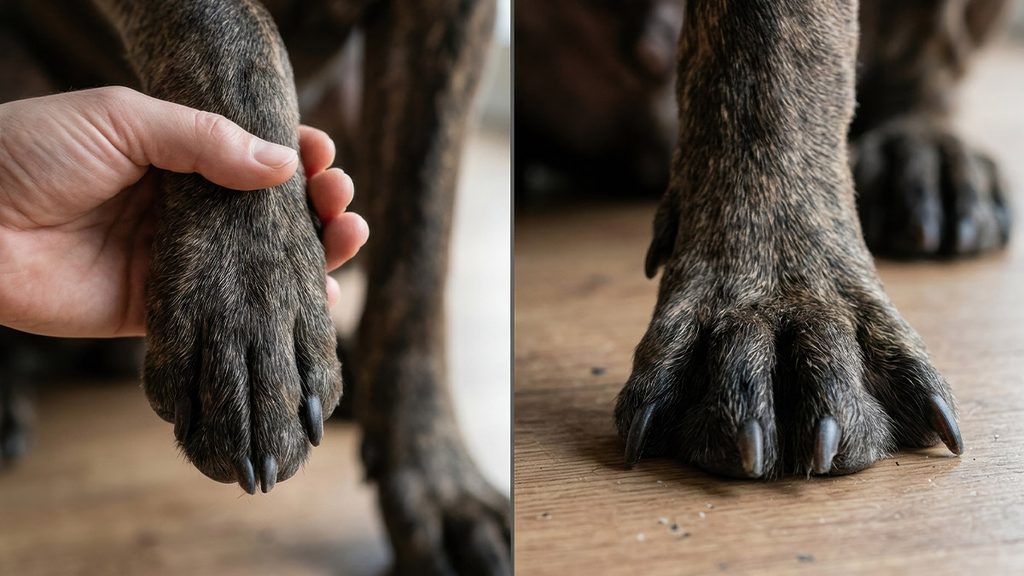
This is the most commonly overlooked part of choosing dog boot sizes. The four boots in the box might not match your dog’s four feet.
Many dog boots come as a set of four in a single size. That’s convenient when every paw fits, but your dog’s anatomy never agreed to that arrangement.
Why front paws are often wider
Dogs carry more of their body weight on their front legs. The figure usually quoted is roughly 60%, though it shifts with posture, movement, breed, and build. Because the front feet do more of the work, they’re often broader or shaped a little differently from the hind feet.
Some dogs show a clear difference. Others measure almost the same on all four paws. You can’t know which kind of dog you have until you measure, so don’t assume a standard gap of 0.2 to 0.5 inches.
What happens when all four boots are the same size?
Say your dog’s front paws measure 2.5 inches wide and the hind paws measure 2.1 inches.
If you size for the front paws, the rear boots will have extra room inside. On a walk, those back boots tend to twist sideways, slide down, or come off completely. If you’ve ever walked back along a snowy trail looking for a lost boot, you know how frustrating that is.
If you size for the hind paws instead, the front boots will squeeze the toes.
That’s why checking the front vs back dog paws size difference improves both comfort and how well the boots stay on.
Should you buy separate front and rear sizes?
If the difference is significant, mixing sizes, with one pair for the front and one for the back, often gives the best fit.
First, check whether the brand offers split sizing or sells individual pairs. Boot models differ in internal shape, closure style, and sizing method, so follow that brand’s guidance when you mix sizes.
If your current boots fit the front paws but keep slipping off the back feet, read dog boots keep falling off for more troubleshooting tips.
How to Measure for Dog Boots: The 4-Step Paper & Tracing Method
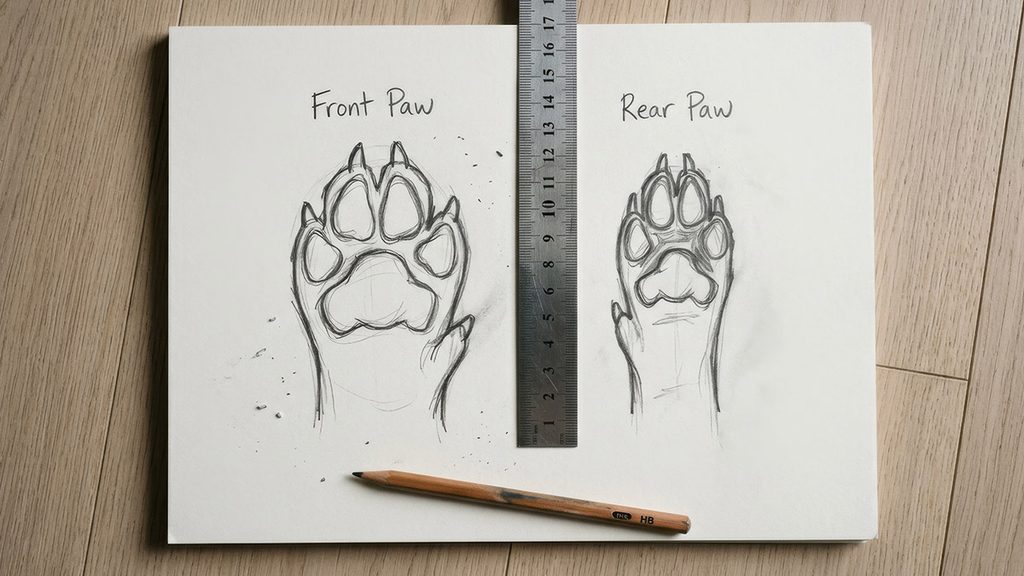
You don’t need special tools to figure out how to measure for dog boots. A simple paper tracing gets you the numbers you need for a confident dog boot sizing and fit decision.
Gather these before you start:
- A sheet of paper larger than your dog’s paw
- A pencil or fine-tip pen
- A ruler or soft measuring tape
- The size chart for the specific boot you’re considering
- A helper and a handful of treats, if your dog needs encouragement to stand still
Timing tip from experience: Measure after a walk or a play session. A slightly tired dog stands still far more willingly than one who just woke up from a nap and wants to play.
Measure each paw separately if you can. At the very least, compare one front paw with one hind paw.
Step 1: Weight-Bearing Paper Placement
Put the paper on a hard, level floor. Carpet lets the paw sink in and blurs the outline.
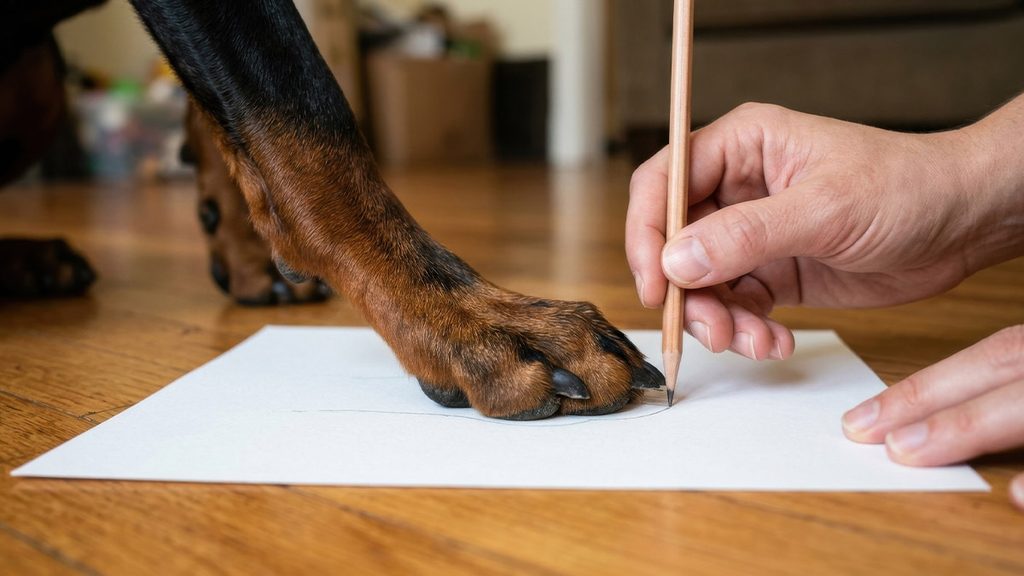
Encourage your dog to step onto the paper with the paw you’re measuring fully on the sheet. Check that the toes aren’t curled under and that no part of the paw hangs off the edge.
Give your dog a moment to settle into a relaxed stance. You don’t need to lift the opposite paw or push weight onto one leg. A natural standing position is enough.
If your dog gets nervous, keep sessions short and use treats generously. A lick mat smeared with a little dog-safe peanut butter and stuck to the fridge at nose height works very well. Never hold the leg down by force. A dog who learns that “paper means wrestling” won’t stand nicely for the next try.
Step 2: Marking the Widest Paw Edges
Hold your pencil straight up and down and make a mark on the left and right sides of the paw at its widest point.
Keep the pencil close to the paw without pressing into the toes or nudging the paw inward. A tilted pencil can add or remove several millimeters, which matters a lot when you’re choosing between XS and S.
Include the outer edges of the toes and any fur that naturally sits flat, since the boot has to hold that too. Don’t spread the toes apart or stretch the paw.
Measure the distance between your two marks. That’s your paw width.
Practical tip: If your dog has thick, tufty fur between the toes (we’re looking at you, Golden Retrievers and Shih Tzus), trim only the excess that keeps the paw from sitting flat. Don’t shave close to the skin just to get a smaller number. The boot needs to fit your dog as they really are.
Step 3: Measuring Claw-to-Heel Length
Measure from the back edge of the main (metacarpal) pad to the tip of the longest toenail, unless the manufacturer tells you to measure differently.
Keep the ruler in line with the paw’s natural direction rather than measuring at an angle.
Whether you include the nails matters. If the chart measures to the nail tip and you leave the nails out, the boot may be too short and press on the toes with each step. Sizing methods vary, though. Some brands measure only the pad area, while others use the full loaded outline including nails.
Always use the measuring points of the specific chart you’re reading. A measurement only works with a chart that defines length the same way.
Write down both width and length, ideally in inches and centimeters, since brands use different units.
For an interactive measuring walkthrough and early training tips, read how to measure dog paws and train them.
Step 4: Comparing with Sizing Charts
With your numbers written down, open the dog shoe size chart for the product you’re considering.
Don’t pick a size from breed or weight alone. A stocky French Bulldog and a lean Border Collie can weigh about the same and still have completely different paws.
Use this process:
- Find the size range that includes your dog’s paw width.
- Check that the listed length also fits the paw.
- Confirm whether the brand sizes by width, length, or both. Many boots are sized width-first.
- Follow the brand’s specific advice if your dog falls between sizes.
- Test the fit indoors before the first outdoor walk.
What if your dog falls between sizes?
There’s no universal rule to always size up or always size down.
If the smaller size squeezes the toes or leaves no room for the nails, don’t force it. If the larger size spins or slips when your dog walks, it’s too big, even if the paw feels comfortable inside.
Think about what’s inside the boot as well. Fleece or insulated linings take up space. If you plan to use boot liners or socks underneath, check whether the manufacturer’s sizing allows for that extra layer. The waterproof vs breathable dog boots guide explains how different materials affect fit and comfort.
For stretchy knit shoes, follow that product’s sizing advice. Don’t automatically size down because the fabric stretches.
The goal stays the same: enough room for the paw, without extra movement.
Dog Boot Size Chart: A General Reference (and Why Every Model Is Different)
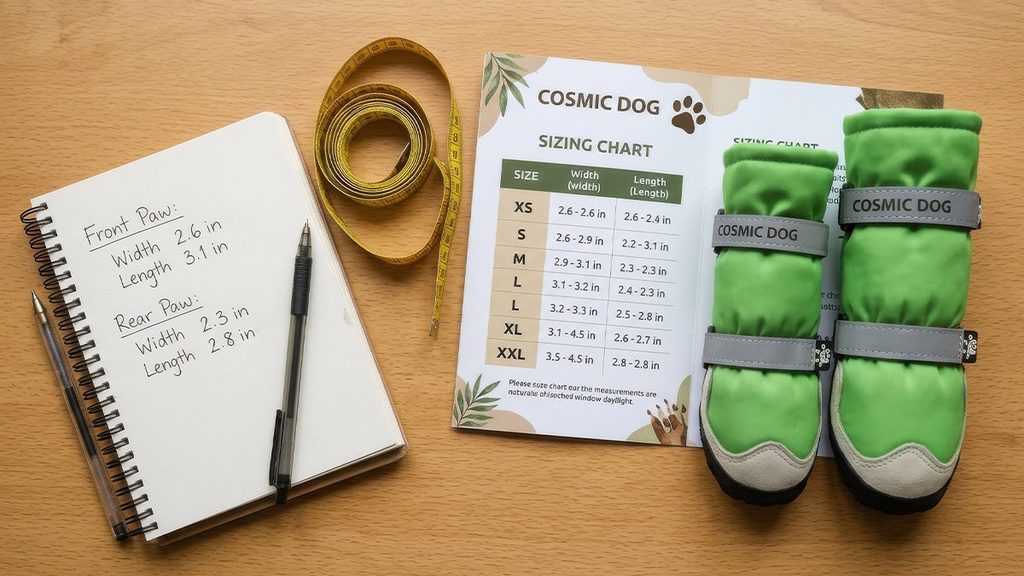
A dog boot size chart helps you understand roughly where your measurements fall. Before you look at the table below, though, you should know that dog boot sizes are not standardized.
Labels like XXS, XS, S, M, L, XL, XXL, and 3XL mean different things from brand to brand, and often from one model to another within the same brand. Our own range is a good example. A stretchy anti-slip sock, a flexible everyday shoe, and a structured waterproof boot are each built on a different last, with different materials and closures. Even when all three say “Medium,” they won’t fit the same paw in the same way.
That’s why we don’t use one universal size standard across our products, and we suggest you don’t rely on one either. The table below shows how sizes generally scale. Use it to get your bearings, then pick your size from the chart on the product page of the boot you’re buying.
| Size | Approx. Paw Width | Approx. Paw Length | Breeds Often in This Range |
|---|---|---|---|
| XXS | Under 1.0 in / 2.5 cm | Under 1.2 in / 3.0 cm | Very small Chihuahuas, toy breeds |
| XS | 1.0–1.3 in / 2.5–3.3 cm | 1.2–1.6 in / 3.0–4.1 cm | Chihuahuas, Yorkshire Terriers |
| S | 1.3–1.7 in / 3.3–4.3 cm | 1.6–2.0 in / 4.1–5.1 cm | Small terriers, some smaller Corgis |
| M | 1.7–2.1 in / 4.3–5.3 cm | 2.0–2.5 in / 5.1–6.4 cm | Corgis, smaller Border Collies |
| L | 2.1–2.5 in / 5.3–6.4 cm | 2.5–3.0 in / 6.4–7.6 cm | Border Collies, smaller Golden Retrievers |
| XL | 2.5–2.9 in / 6.4–7.4 cm | 3.0–3.5 in / 7.6–8.9 cm | Golden Retrievers, many Labradors |
| XXL | 2.9–3.3 in / 7.4–8.4 cm | 3.5–4.0 in / 8.9–10.2 cm | Larger large-breed dogs |
| 3XL | Over 3.3 in / 8.4 cm | Over 4.0 in / 10.2 cm | Some giant breeds, depending on actual paw size |
How to read this chart: These ranges are approximate and only meant to show how sizing progresses. Width and length don’t always land in the same row. A dog with wide, short paws may need one size by width and another by length. When that happens, the product’s own chart decides. So what are the best sizes for dog boots? The ones that match your measurements on the chart for the boot you’re buying.
Why breed names are only a rough guide
Breed gives you context, but it can’t replace a tape measure.
Two dogs of the same breed can differ in build, age, weight, and paw structure. We’ve seen littermates end up two sizes apart. Treat the breed column as a sanity check after you’ve measured, not a shortcut.
Small & Toy Breeds (XXS–Small)
For small dogs, the paw is only half of the fit. The other half is the ankle.
When you’re shopping for Chihuahua boots or other extra small dog boots, look closely at the opening and the fastening. Plenty of XS dog boots fit the paw width well but have an opening too wide to stay put on a slim little leg. One brisk trot and the boot is gone.
When you compare XXS dog boots or xxsmall dog boots, check:
- Whether there’s enough room at the toe for the nails
- Whether the closure tightens enough without squeezing
- Whether the boot stays centered as your dog walks
- Whether the sole bends easily for a lighter dog
- Whether the boot is light enough that your dog walks normally
Weight matters a lot at this size. A boot that a Labrador wouldn’t notice can feel like an ankle weight to a 4-pound Chihuahua. Lightweight XXS dog shoes with flexible soles usually go over better than heavy, rigid styles.
For Chihuahua winter boots, think about insulation, water resistance, and lining thickness. A heavily lined winter boot often fits differently from a light summer shoe in the same size, so measure for the specific boot. Some soft, fleece-lined booties are sold as dog mittens. They’re more forgiving than structured boots, but they still need the right width and a secure cuff to stay on.
Large & Giant Breeds (XL–3XL)
Big dogs put serious force through their feet with every stride, turn, and sudden lunge at a squirrel. Large breed dog boots have to handle both the paw’s dimensions and that force.
For dog shoes for big dogs, width usually matters most. A narrow toe box can pinch the toes as soon as a 90-pound dog puts weight down.
When comparing big dog shoes, large dog booties, extra large dog boots, or extra large dog shoes, look for:
- A toe box wide enough for a loaded paw
- A durable outsole that won’t wear through on concrete
- Closures that stay secure without heavy tightening
- Enough interior length for the nails
- A sole suited to your terrain, whether that’s city sidewalks, gravel, or rocky trails
The same checklist applies if you’re shopping for 3XL dog boots, XXXL dog boots, or XXXL dog shoes. Don’t assume a giant breed needs the biggest size. Some large dogs have surprisingly narrow paws, and some compact, broad-chested breeds have very wide feet.
If your big dog spends weekends on rough ground, read dog hiking boots and dog boot soles and traction to match the sole to the terrain.
Special considerations for Bulldogs
Bulldogs break most sizing rules. Their paws are often broad, their legs are short and sturdy, and their front feet may turn out slightly. Breed-and-weight guesses are especially unreliable for them.
When shopping for bull dog shoes or any wide-fit footwear, go by the actual paw measurements and the shape of the toe box. A boot can be long enough and still too narrow. A boot wide enough for the toes can still leave a gap at the heel.
Choose by dimensions and fit, not the breed name on the label.
Evaluating the Fit: How to Tell If Boots Are Too Tight or Too Loose
Picking a size from the chart is only half the job. Good dog boot sizing and fit is confirmed on your dog’s actual feet.
The boot should stay secure while your dog moves without pinching the toes, rubbing the skin, or restricting natural joint movement. Do these checks in a calm, supervised indoor fitting session, preferably on a non-slip rug rather than polished hardwood.
1. Check the Strap Tension
Fasten the straps as the manufacturer instructs.
The boot should stay in place without being cranked tight. With many strap designs you can slide one finger under the strap. Treat that as a quick check, not a rule for every closure type.
If the boot keeps slipping, don’t just tighten the strap another notch. First check whether the size, opening shape, or strap position is the real problem.
Signs a strap is too tight include deep strap marks after removal, puffiness, skin discoloration, or your dog repeatedly licking or chewing at the boot.
2. Check Toe Clearance
With the paw inside, gently press around the front of the boot with your thumb, the way a shoe store clerk checks a child’s sneakers.
The toes and nails shouldn’t be jammed against the toe cap. The paw should sit naturally, but the inside shouldn’t be so roomy that the foot slides back and forth.
There’s no magic clearance number like 2 to 4 mm that works for every boot. The right amount of space depends on the boot’s construction, your dog’s paw, and the brand’s sizing method.
If the longest nail presses into the front of the boot or the toes look scrunched, reassess the size.
3. Check the Dewclaw and Ankle Area
The dewclaw sits higher up on the inner side of the leg, separate from the main paw pads. Depending on the boot’s height and cuff design, the top edge or strap can rub right on it.
After the first few short sessions, take the boots off and look closely. Part the fur around the dewclaw and ankle and check for pink spots, damp fur, or flattened hair that suggests friction.
A boot can fit the paw perfectly and still be wrong if its cuff keeps catching the dewclaw.
As noted in VCA Animal Hospitals’ foot pad care guidelines, overtightened straps can compromise circulation and cause friction sores around the ankle and dewclaw.
4. Watch Your Dog Walk
Let your dog walk a short distance on a familiar indoor surface and watch closely.
Look for:
- Boots twisting around the paw
- Heels slipping out the back
- Straps working loose
- Repeated attempts to kick off or chew at the boots
- Unusual changes in stride
- Tripping or scuffing from boots that are too long
Many dogs do the famous high-stepping dance the first time they wear boots, lifting each leg like a parade horse as if the floor has turned to lava. It’s funny, it’s normal, and it usually fades with gradual, treat-filled practice. Our guide on how to get dog used to shoes walks you through that process step by step.
There’s a line to watch for, though. Funny walking that improves over a few sessions is adjustment. Limping, refusing to put a foot down, or an awkward gait that persists isn’t a training problem. Take the boots off, check the paws, and talk to your vet if anything seems wrong. Senior dogs with thinner skin and less padding deserve extra care here. See paw friction for senior dogs.
If the fit still isn’t working, explore rugged waterproof dog boots, breathable dog shoes, or indoor anti-slip socks, depending on how and where your dog will wear them.
For more guidance on safe handling and helping dogs adapt to footwear, see the American Kennel Club’s dog boot guidance.
Frequently Asked Questions (FAQ)
Should dog boots be snug or loose?
Snug, but not tight. The boot should stay put without sliding around inside, and it should never squeeze the toes or leave pressure marks.
Quick check: the paw sits naturally, the nails aren’t pushing into the front, and the strap holds without heavy cranking. If the boot spins, it’s too loose, the wrong shape, or fastened wrong. If you see pinching, redness, or a sulky dog, it’s probably too small.
What happens if I buy dog boots that are too big?
They twist, slip, flop, and fly off. Oversized boots can also catch on the ground and trip your dog mid-stride.
Extra material can bunch up inside, too, so a loose boot can still rub even when the strap feels secure. Before you tighten it harder, compare your dog’s measurements with the product’s chart again and check whether the heel and opening shape suit your dog’s leg.
How do I measure my dog’s paw if they won’t stand still?
Make it a game, not a struggle. Keep sessions short, use high-value treats, and try a lick mat at nose height to keep your dog busy and standing naturally. A helper who holds the paper and records numbers makes it twice as easy.
If paper tracing isn’t working, try a paw print with a pet-safe, washable, non-toxic medium. Keep in mind that a print may not capture the full standing width perfectly. Never lift or hold down a sore leg. If your dog can’t stand comfortably, ask your vet about another way to measure.
Why do my dog’s front boots fit fine while the back ones slide off?
Most likely, the back paws are narrower than the front ones. That’s very common. The rear boots end up with extra room, and extra room leads to slipping.
Measure the front and back paws separately, then see whether the brand offers split sizing or individual pairs.
It’s tempting to stuff a sock in to fill the gap, but that often backfires. Extra fabric can bunch up, change the fit, and create new pressure points. Only add socks underneath if the manufacturer says the boot works with them and the fit stays secure.
More fixes here: dog boots keep falling off.
Should I include my dog’s toenails in the length measurement?
Do whatever the size chart says. Some brands measure to the tip of the longest nail. Others use a different point.
If the chart includes nails and you leave them out, you’ll probably end up with a boot that’s too short. If the chart excludes nails and you include them, you may size up when you don’t need to.
Either way, keep the nails trimmed to a healthy length. Long nails make any boot feel tight and can change how your dog walks. For nail and pad care basics, see dog paw care 101.
How do I choose the right dog boot size for a Chihuahua?
Measure first, shop second. Take your Chihuahua’s paw width and length using the brand’s method, then compare them with that brand’s XXS and XS ranges. A “made for Chihuahuas” label doesn’t guarantee a fit.
Pay close attention to the ankle opening, how far the strap adjusts, and overall weight. Tiny dogs often refuse heavy or stiff footwear, so lightweight and flexible usually wins. For Chihuahua winter boots, allow for the lining without letting the boot get loose.
How do I choose dog shoes for a large or giant breed?
Measure each paw you’re fitting and check both width and length against the product chart.
Then focus on three things: a toe box wide enough for a loaded paw, an outsole tough enough for your terrain, and a closure that stays secure through sharp turns and sudden starts. Labels like “big dog shoes” or “3XL dog boots” help you find the right section of the store, but only your measurements tell you the right size.
Can I use the same size chart for every dog boot brand?
No, and often not even for every model within one brand.
Brands use different sizing methods, internal shapes, materials, and closures. Two boots both labeled “Large” can fit very differently. Always use the chart for the exact product you’re buying, and measure again whenever you switch styles, for example from a soft sock-style shoe to a structured waterproof boot.
Make Paw Care Part of the Sizing Process
The right size is a big part of choosing dog footwear, but it isn’t everything. Where and when your dog wears footwear matters just as much.
Waterproof boots, breathable summer shoes, insulated winter boots, and indoor anti-slip socks are each built differently for different jobs. If you’re not sure which type your dog needs, start with our comprehensive dog paw wear guide.
Here are a few habits that help the fit keep working:
- Summer walks: Press the back of your bare hand on the pavement for seven seconds. If you can’t keep it there comfortably, it’s too hot for bare paws. See our guide on protecting dog paws from hot summer pavement.
- Indoor slipping: For dogs who skid on smooth floors, a well-fitted sock does more than a boot. Learn more in our anti-slip dog socks guide.
- Evening walks: Reflective details help drivers see your dog after dark. Read our guide on reflective dog boots for night walking safety.
- Keeping them fresh: Dirty, stiff, or shrunken boots fit differently over time. Follow our step-by-step tutorial on how to clean dog shoes to keep them in shape.
Re-measure every season, too. Puppies grow, older dogs’ paws can splay, and weight changes affect paw shape more than most owners expect.
Measure Twice, Adventure Forever with the Perfect Fit!
Don’t let a sizing guess turn your dog’s favorite walks into a hobbling, boot-chasing ordeal. Footwear that matches your dog’s natural standing paw shape is more likely to stay on, less likely to rub, and better at keeping steady contact with the ground. Your dog can stop worrying about their feet and get back to enjoying the walk.
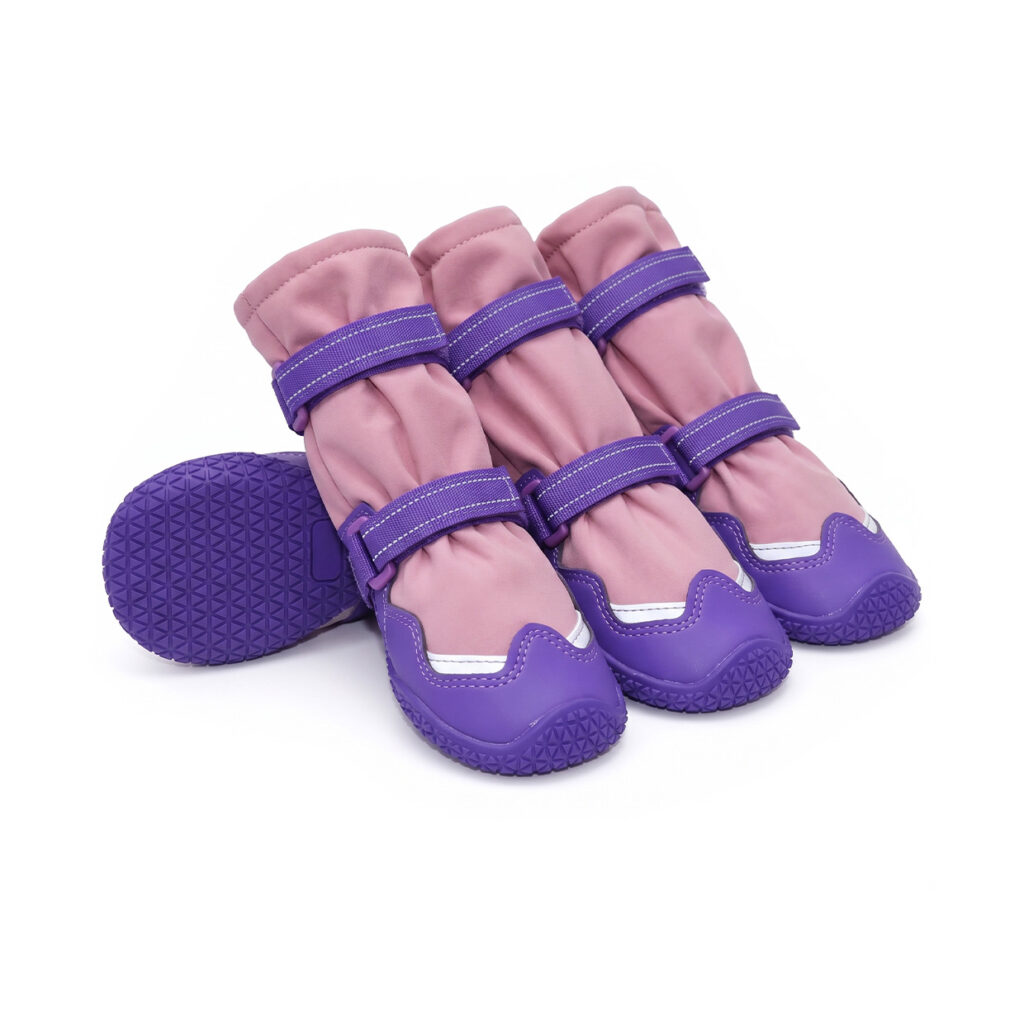
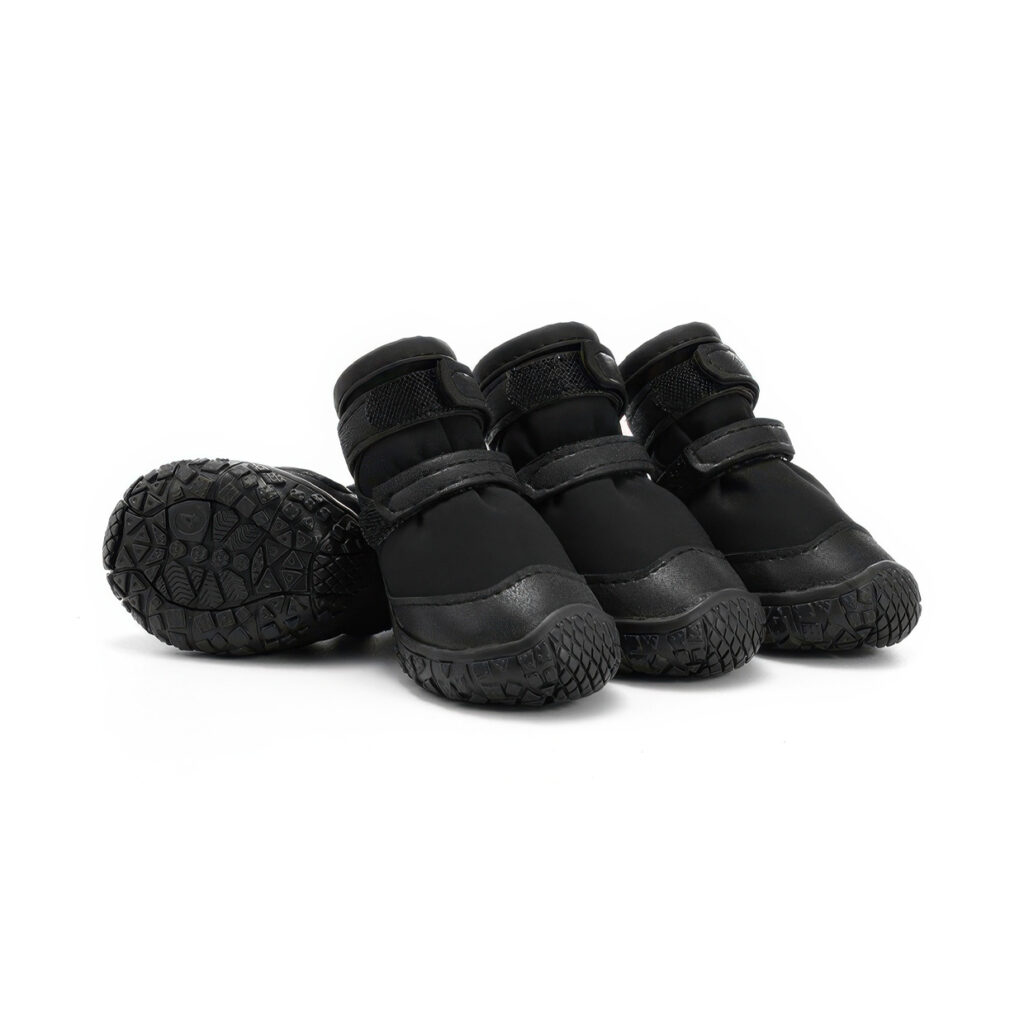
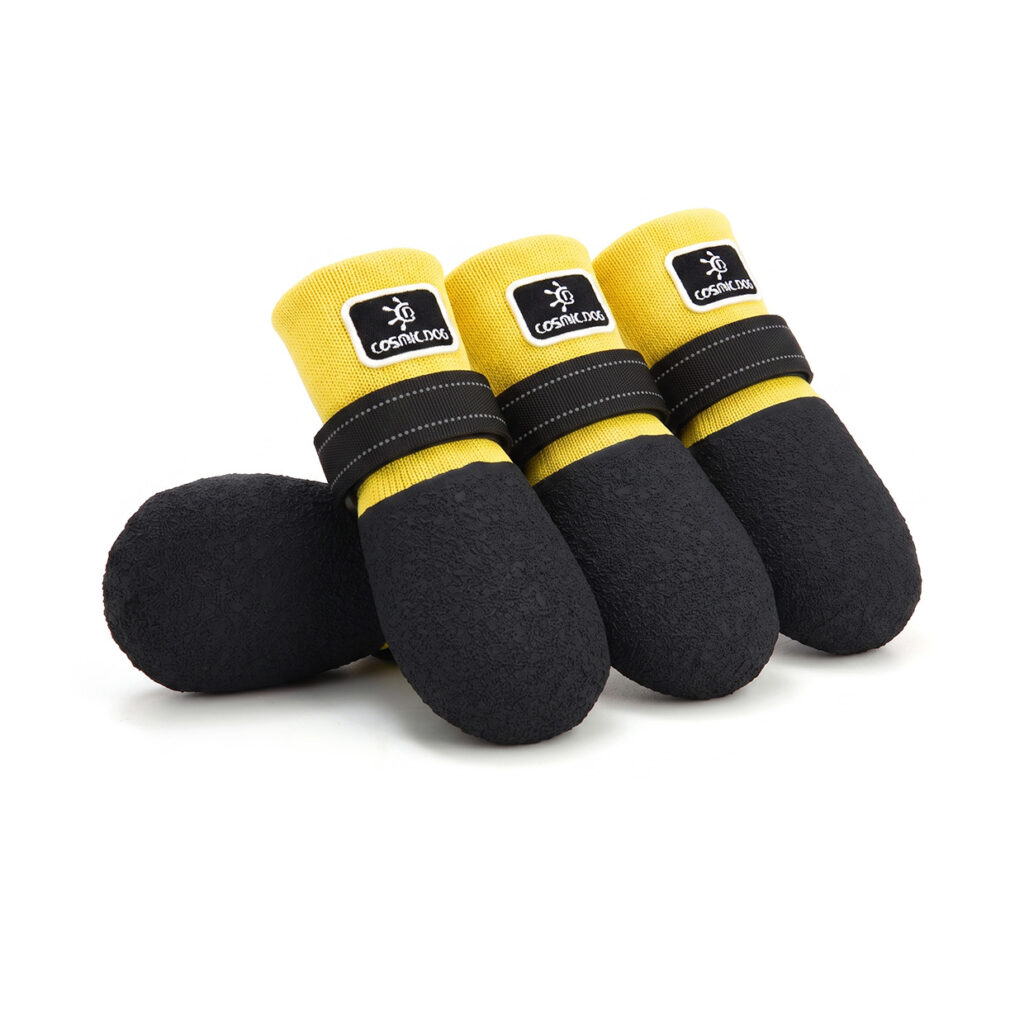
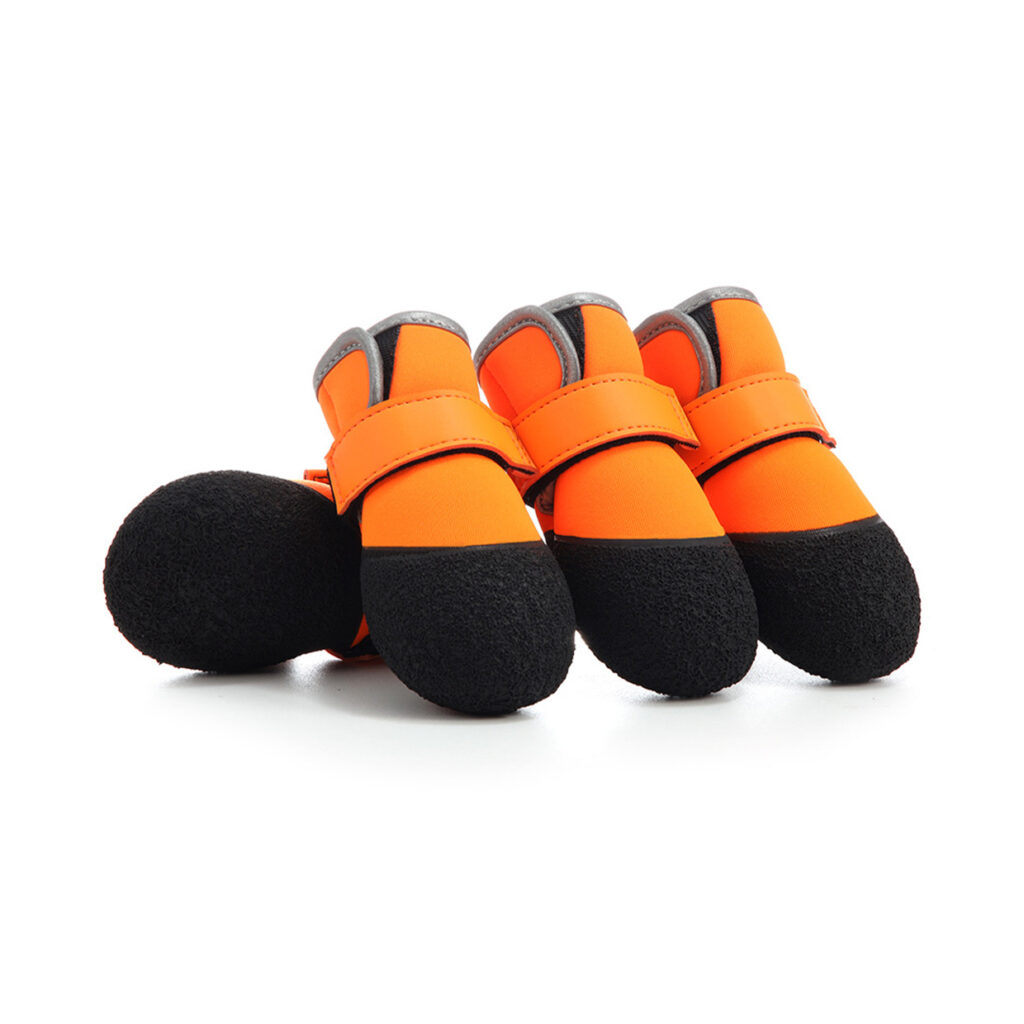
Explore Paw Clad’s collection of all-terrain dog boots, flexible everyday dog shoes, and anti-slip dog socks to find footwear that suits your dog’s measurements and daily routine. Each product has its own size chart, built around how that specific style fits.
Look for a toe box with room to spread, a fastening system that’s secure without being tight, and a sole designed for the surfaces your dog walks on.
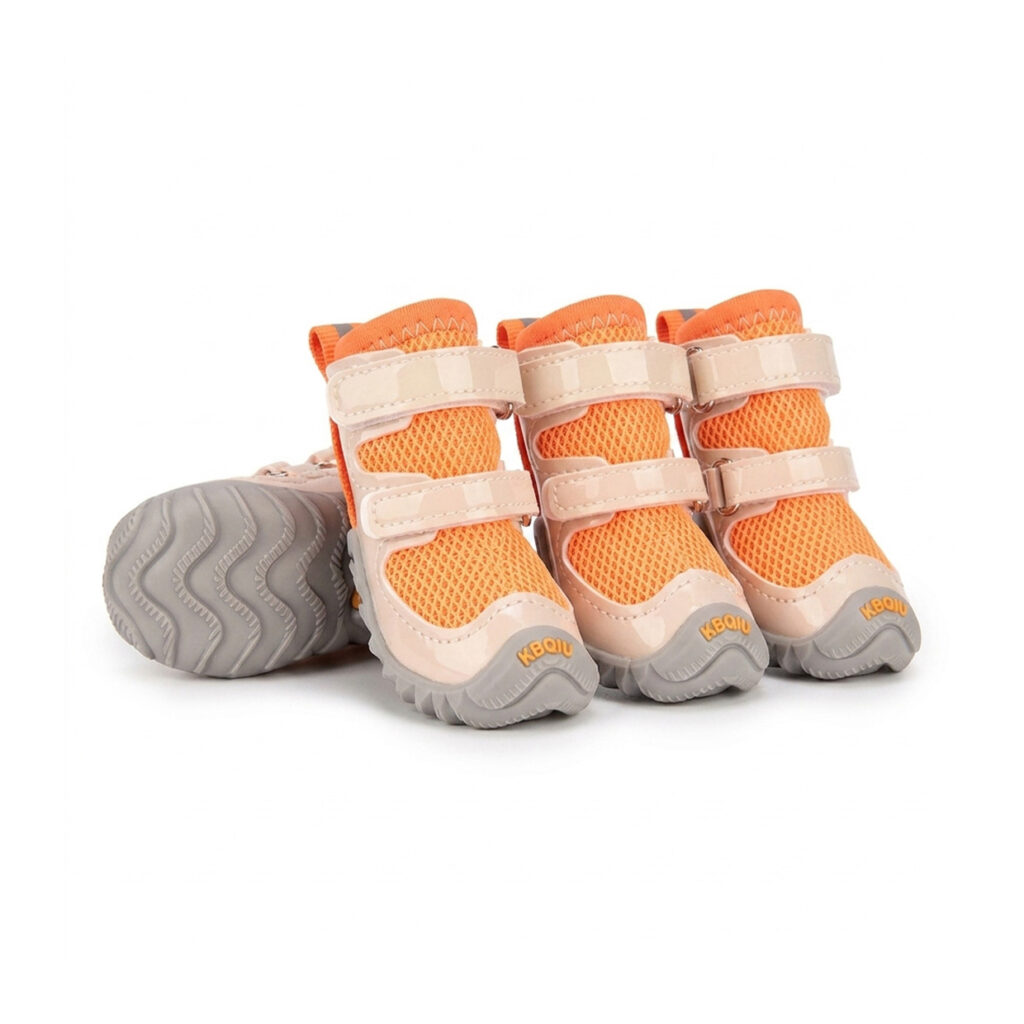
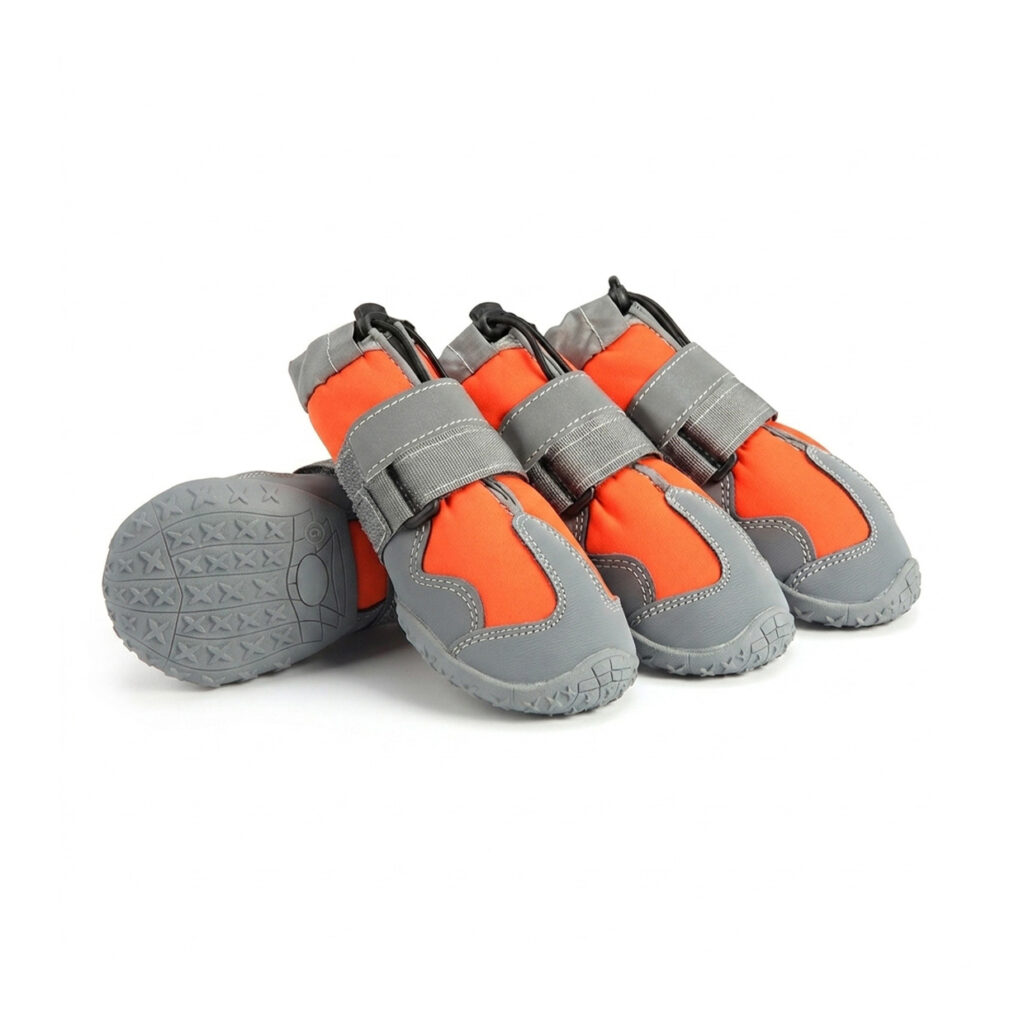
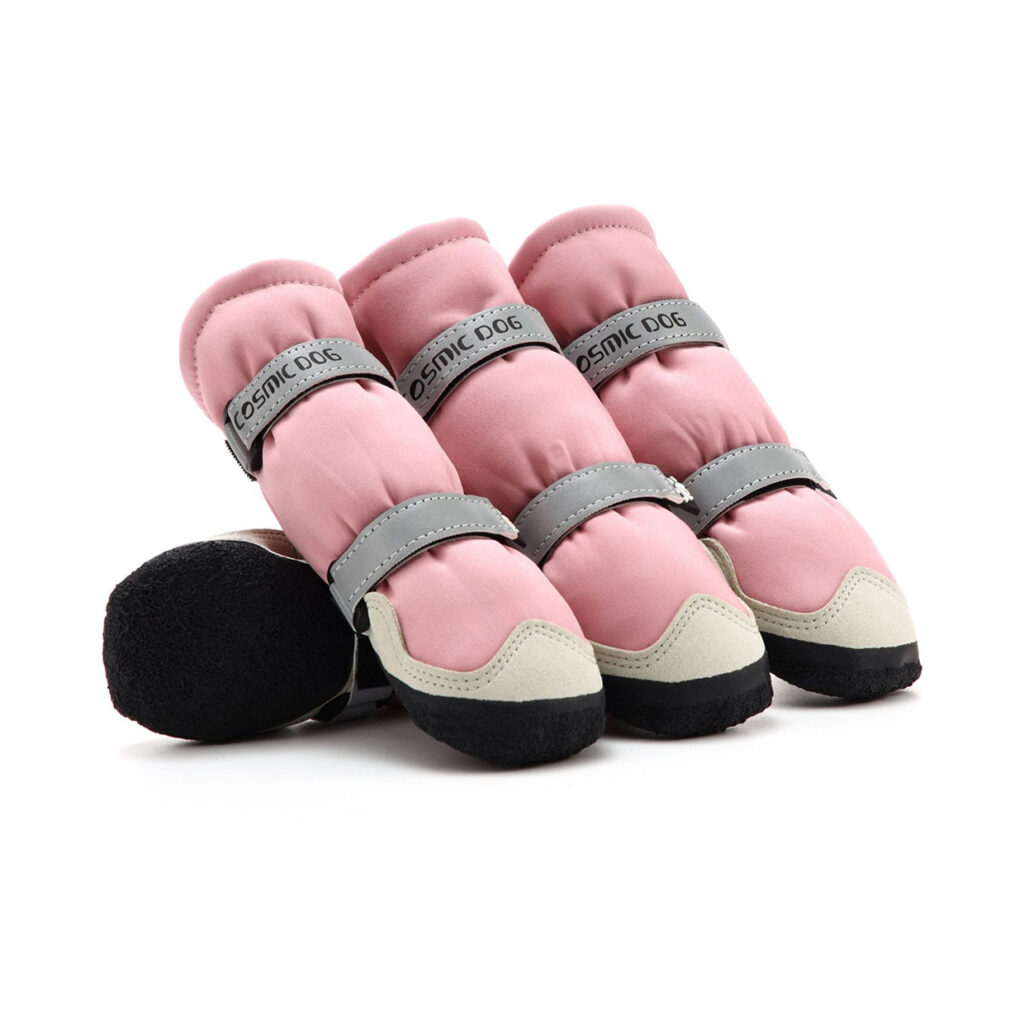
Explore Our Universal Size-Match Dog Footwear
Measure accurately. Check the fit. Make every step count.